When a fragrance shipment disappoints, the argument is rarely about chemistry. It is about paperwork: nobody can prove what was agreed, what was tested, or what the batch was supposed to match. Collecting the right documents before the purchase order is released turns those arguments into comparisons. Collecting them afterwards is usually impossible.
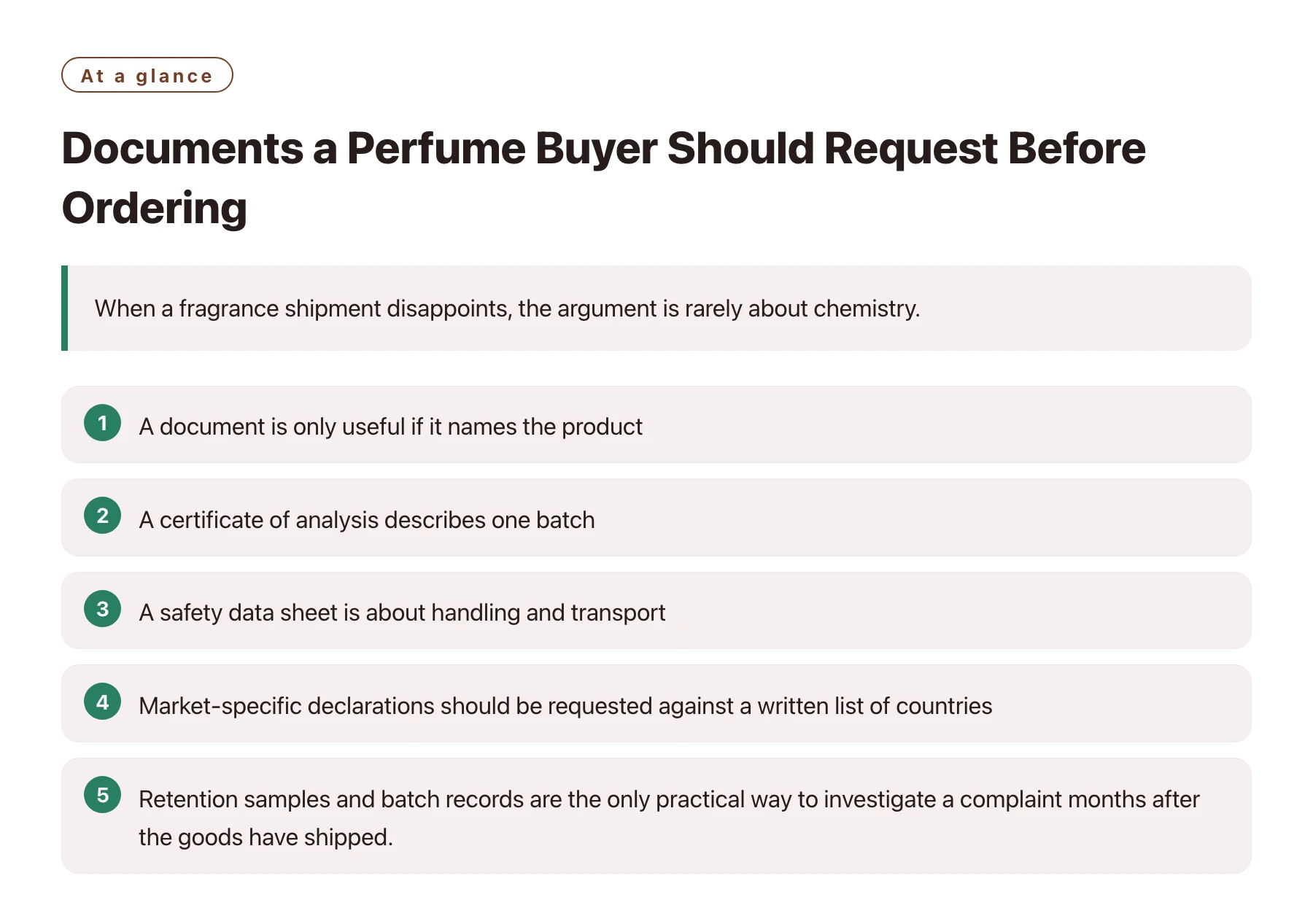
Key takeaways
- A document is only useful if it names the product, the batch and the standard it was measured against, so read those three fields first.
- A certificate of analysis describes one batch, while a specification describes the product; confusing the two causes most quality disputes.
- A safety data sheet is about handling and transport, not about whether a perfume is safe to sell in a given market.
- Market-specific declarations should be requested against a written list of countries, because the requirements genuinely differ.
- Retention samples and batch records are the only practical way to investigate a complaint months after the goods have shipped.
Buyers usually ask for certificates at the wrong moment. The request goes out after the samples are approved, when the schedule is tight and the supplier is busy, and what arrives is whatever template was closest to hand.
The result is a folder that looks thorough and answers nothing. Documents are evidence, and evidence has to be specific: a named product, a named batch, a named standard and a date.
This reference lists the paperwork worth holding before an order is released, together with the limits of each item, because knowing what a document does not prove is as useful as knowing what it does.
The core document set, and what each one is for
| Document | What it actually tells you | When to request it | The common gap |
|---|---|---|---|
| Product specification | The agreed characteristics of the product as a standard | Before sampling is signed off | Written loosely, so nothing can be measured against it |
| Certificate of analysis | Measured results for one specific batch | With each shipment | No batch number, so it cannot be tied to the goods |
| Safety data sheet | Handling, storage and transport information | Before the first shipment moves | Treated as proof of market compliance, which it is not |
| Allergen declaration | Which declarable fragrance allergens are present, and at what level | Once the formula is locked | Requested after artwork, forcing a label revision |
| Compliance statement | The industry standard the formula was assessed against | At formula lock, per product type | Issued for a different product category |
| Retention sample record | Which reference batch is kept, where, and for how long | Before the first bulk order | No agreed retention period or storage condition |
Six documents, one page. The pattern in the last column is consistent: most gaps come from timing rather than from unwillingness, because a document requested at the wrong moment cannot contain the right information.
How to run a document check before the order
- Write the market list firstName every country the product will be sold in, since declarations are prepared against markets rather than against products.
- Ask for the specification as a measurable documentCharacteristics such as appearance, odour, and any physical values should be stated in a form two people can check independently.
- Tie every certificate to a batch numberA certificate without a batch reference cannot be matched to the goods you receive, which makes it decorative.
- Confirm the retention arrangement in writingAgree how long reference samples are kept, how they are stored, and who may request a comparison.
- Check the artwork against the declarationsMake sure the label wording and the allergen list come from the same locked formula version.
- Keep your own copy outside the supplier's systemDocuments held only in a supplier portal are difficult to produce when a distributor or an inspector asks.
Three documents that are routinely misunderstood
Some items in a document pack are read as blanket assurances, when in fact each one answers a narrow question. Three of them cause disproportionate confusion.
Understanding their limits does not make them less valuable; it makes them useful in the right conversation.
A specification is not a batch result
The specification is the standard: what the product is supposed to be. A certificate of analysis is the measurement: what one batch turned out to be. Buyers who hold only a specification have a target with no scorecard, and buyers who hold only certificates have measurements with nothing to compare them against.
Ask for both, and check that the certificate references the specification version that was approved.
A safety data sheet is not a market approval
Safety data sheets exist so that everyone handling or transporting the material knows how to do it safely. They say nothing about whether the product may be sold, how it must be labelled, or which ingredients must be declared.
Those questions belong to the market framework. In the European Union, for example, the public Cosmetic Ingredient Database is a reference for ingredient names and functions [1], and it is a starting point for checking a formula rather than a substitute for the required declarations.
Ingredient lists follow the market, not the product
The same bottle sold in two countries can require two different sets of information. Health Canada, for instance, publishes the cosmetics requirements that apply to products sold in Canada, including safety and notification obligations [2], and those obligations sit alongside whatever the brand already holds for another market.
This is why the market list belongs at the top of the request and not at the bottom. A supplier preparing documents for three markets prepares a different pack from one preparing for one.
The most expensive documentation failure is a container held at a border for a document that could have been prepared weeks earlier. Customs and market authorities do not negotiate on paperwork, and the goods sit while the consignment accrues cost. Build the document list into the production schedule rather than treating it as a formality after packing. Independent testing providers describe the checks available for cosmetics and personal care products [3], and knowing which of them your markets expect is part of the same planning exercise. Suppliers such as Xuelei prepare these packs routinely for the markets they serve most often, which is why the market list should be sent before the request rather than after it.
Where documentation requests go wrong
Once the list is right, two habits decide whether the paperwork actually protects the brand.
Both are about treating documents as living records rather than as a one-off collection exercise.
Templates are accepted without scope
A compliance statement or certificate is only meaningful if its scope covers your product type and the site that made it. The scope wording is often the shortest paragraph on the page and the only one that matters.
Photograph the certificate, note the scope, the issuing body and the expiry date, and diarise the renewal. Suppliers change certificates without announcing it.
Documents stop at the purchase order
A pack assembled for the first order goes stale. Formulas are modified, suppliers change, labels are revised, and a folder that was accurate last year can be misleading this year.
Refresh the set whenever the formula changes or a new market is added, and keep one current folder per product.
Nobody reads their own copies
Suppliers that export widely, such as Xuelei China, normally keep a document pack ready for the markets they serve most often, but the pack is only as good as the market list it was built from. Send an updated list, then read what comes back against it.
Ten minutes spent comparing the declaration list with the artwork and the market list is the cheapest insurance in a fragrance project, because it happens before anything is printed.
Sources
- EU CosIng — Cosmetic Ingredient Database (European Commission) —— The European Commission's CosIng database of cosmetic ingredients, listing ingredient functions, restrictions and labelling requirements under EU cosmetics law.
- Health Canada: Cosmetic Safety —— Health Canada's cosmetics pages, covering cosmetic notification, the ingredient hotlist and safety requirements for cosmetics sold in Canada.
- SGS: Cosmetics, Personal Care & Household Testing —— Testing, inspection and certification services for cosmetics and personal care, including microbiological, stability and safety testing aligned with cosmetics GMP.
Frequently asked questions
What documents should I get from a perfume manufacturer?
At minimum a measurable product specification, a batch certificate of analysis with each shipment, a safety data sheet for handling and transport, an allergen declaration for the locked formula, a compliance statement covering your product type, and a written retention sample arrangement.
Is a certificate of analysis the same as a specification?
No. The specification states what the product is supposed to be, while the certificate of analysis reports what a particular batch measured. You need both, because a measurement is only meaningful when it can be compared against an agreed standard for the same version.
Do I need allergen information before designing the label?
Yes, if your markets require allergen declarations. The list follows the locked formula, so requesting it after artwork is finished risks a label revision and, in some markets, renewed notification work. Ask for it at formula lock and design the label around the answer.
What does a safety data sheet prove?
It documents how the material should be handled, stored and transported. It does not establish that the product may be sold in a market, nor does it cover labelling or ingredient declaration duties, which are separate obligations under each market's rules.
How long should a factory keep reference samples?
Long enough to cover the shelf life of the products made from that batch plus any reasonable complaint window, and stored under conditions that keep them stable. Agree the period and the storage arrangement in writing, because an unstable or discarded reference cannot support a comparison later.