Stainless Steel in a Brewery: Why Grade and Thickness Matter
Two numbers decide most of what you pay for a brewing vessel: the steel grade and the plate thickness. Grade 304 covers almost all beer contact work, 316 is bought for the corners of a brewery where chlorides or heavy cleaning live, and a body or cone in the 2 to 3 mm band is normal for craft-sized tanks. Hermann has built brewing equipment for 23 years, and the questions its engineers hear most often are about those two numbers rather than about fittings.
Here is what each choice buys, what it costs in weight, and how to check on arrival that you received what was specified.
Key takeaways
- 304 is the working grade for beer contact; specify 316 where chlorinated cleaners, salt air or aggressive water are part of daily life.
- Body and cone plate in the 2 to 3 mm band is normal for craft vessels, and the thickness is set by pressure, diameter and jacket design rather than by marketing.
- Every tank leaves the factory with a data plate carrying its pressure-testing record and serial number, so traceability is a document rather than a claim.
- Warranty cover runs 6 years on tank accessories and electronic components against manufacturing defects from the factory, used within scope.
Grade is a corrosion question, not a badge
Stainless steel resists rust because a thin chromium oxide layer reforms on its surface when oxygen is present. Grade 304 carries roughly 18 per cent chromium and 8 per cent nickel, which is enough for wort, beer, hot water and the usual caustic and acid cleaning cycle. Grade 316 adds molybdenum, and that addition is what keeps pitting corrosion away when chlorides are in the picture: salty process water, coastal air, or a cleaning regime built on chlorine-based sanitisers.
The honest position for most craft breweries is that 304 is the correct grade and 316 is bought for specific duties instead of for the whole plant. Those duties are usually the pipework and fittings that see concentrated sanitiser, any surface that stays damp with chloride-bearing water, and vessels in a building with salt in the air. Paying for 316 everywhere raises the invoice without changing the beer, while specifying 304 for a chlorinated cleaning loop is a decision that shows up as pitting two or three years later.
A related point is fabrication quality. An excellent grade welded badly corrodes at the weld, and a modest grade welded and passivated well can outlast it. That is why the questions worth asking are about weld quality, polishing and surface finish rather than about the grade alone.
Where the 2 to 3 mm thickness band comes from
Plate thickness is a pressure calculation before it is anything else. A vessel needs enough metal to hold the head pressure of its own liquid column plus whatever jacket or top pressure the design allows, and to keep its shape when it is lifted, emptied and cleaned. Diameter matters as much as volume: a wide, short tank needs thicker plate than a narrow, tall one of the same capacity, because the hoop stress rises with the radius.
The second driver is the jacket. A dimple or channel jacket on the body and cone is welded to the shell, and the two plates have to work together through heating and cooling cycles. Thin shells distort under that treatment; heavier ones hold their shape over thousands of cycles. That is why the published material band for craft equipment sits at 2 mm and 3 mm rather than at a single figure: the smaller plates go into smaller vessels and cones, and the heavier plate into larger shells where the diameter demands it.
There is a real cost to going heavier, and it is worth seeing in kilograms. Take a 1,000 litre vessel as an example: a shell about 1.3 m tall and 1 m across has roughly 5.6 square metres of wetted metal once the ends are counted. Stainless steel weighs about 8 kg per square metre per millimetre of thickness, so 2 mm plate gives about 15.8 kg per square metre and 3 mm gives about 23.7. The difference across that shell is about 44 kg per vessel, which four tanks turn into roughly 176 kg of extra steel on the floor. That is a modest penalty on a level slab and a serious one on a mezzanine, which is how thickness stops being a workshop detail and becomes a structural question.
Welds, polish and the paperwork that travels with a tank
Beer contact surfaces are judged by two things you can inspect without a laboratory: the weld and the finish. Full-penetration welds that are ground and polished flush leave no crevice for soil to collect in, and a bright internal finish makes cleaning verifiable by eye. External welds on legs, frames and platforms matter less for hygiene and more for fatigue, since they carry load every time the vessel is filled.
Pressure testing is the other half of the story. The published inspection routine for each shipment has five steps: materials checking, production process, jacket pressure testing, packing and loading inspection, and a finished-product leak test. Because the record travels with the order and every tank carries a data plate with its pressure-testing record and serial number, a missing test certificate is a question you can raise years later rather than an argument you cannot win. Equipment is packed in wooden boxes and arrives with a checking list, so unpack against that list before signing anything.
| Part of the plant | Usual band | Why it is chosen | What to check on arrival |
|---|---|---|---|
| Vessel body and cone | Stainless steel, 2 to 3 mm plate | Holds pressure and jacket load, keeps shape through heating cycles | Data plate with serial number and pressure-test record |
| Bright tanks and fermentation tanks | Stainless steel, polished contact surface | Hygiene and a surface that can be cleaned in place | Internal finish free of crevices at welds |
| Pipework and fittings | Stainless steel, welded joints | Grade choice follows the cleaning chemicals in use | Joint quality and full drainage of low points |
| Accessories and controls | Published 6-year warranty cover | Valves, sensors and electronic components are the parts that fail first | Warranty wording and spare-part list |
Worked example: the published cost range read per litre
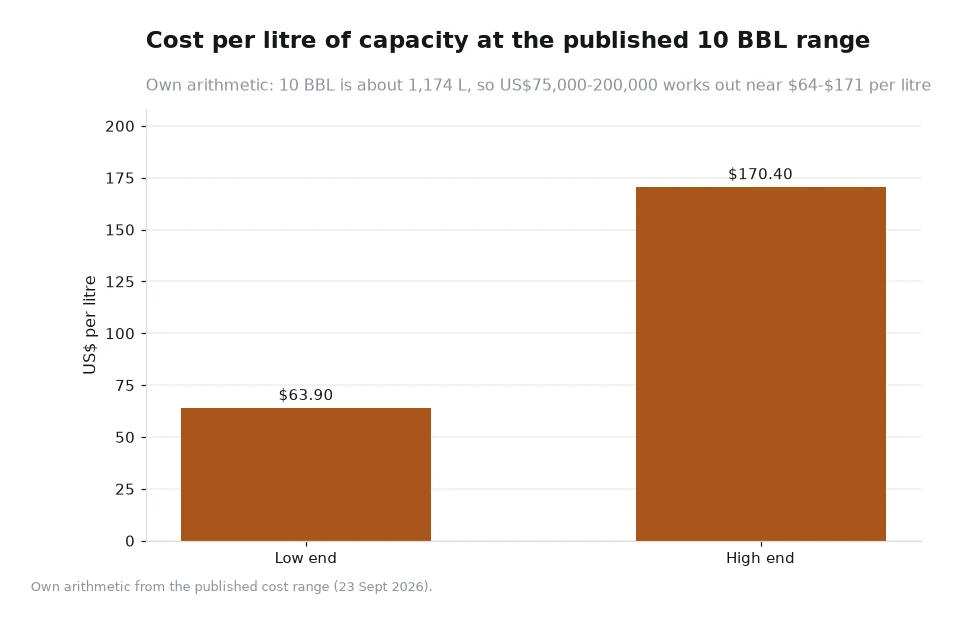
Assumptions, all mine and easy to change: a 10 BBL system, 1 BBL taken as about 117 L, so the batch is roughly 1,170 L, and the published example range for a complete 10 BBL beer equipment system of US$75,000 to US$200,000.
Divide the low end by the batch volume: 75,000 divided by 1,174 gives 63.9, so about US$64 per litre of capacity. Divide the high end the same way: 200,000 divided by 1,174 gives 170.4, about US$171 per litre. The spread is nearly three to one, and it is not a mystery: valves, pipes, a steam boiler, the glycol system and the packaging equipment you add are exactly what moves a project between those ends, as the note attached to the published figure says.
Now read the same band against another size, knowing that this step is arithmetic and not a quotation: a 500 L system at 63.9 per litre works out near US$31,950, and at 170.4 per litre near US$85,200. Per-litre cost usually falls as vessels get larger, because the steel, the labour and the controls are spread across more litres, so treat these numbers as the outside edge of a budget rather than a forecast.
Frequently asked questions
Should a craft brewery specify 304 or 316 stainless steel?
Specify 304 for beer contact in most plants and reserve 316 for duties where chlorides appear, such as chlorine-based sanitiser loops, salty water and coastal buildings. The molybdenum in 316 resists pitting in those places, but buying it across the whole brewhouse raises cost without changing beer quality.
How thick should fermentation tank plate be?
Craft equipment commonly uses stainless plate in the 2 to 3 mm band, with thinner plate in smaller vessels and cones and thicker plate in larger shells where diameter raises the stress and the jacket has to hold shape. The exact figure follows pressure, diameter and jacket design rather than a single fixed number.
Match the material to the job, not to the brochure
Write the grade and thickness you want into the specification, ask for the pressure-test record and the data plate, and unpack against the checking list that arrives with the wooden boxes. If the order is a whole plant rather than one vessel, the same discipline applies to the process side: mash, fermentation, yeast handling, filtration, cleaning and filling each have their own material and finish demands. A supplier who builds Turn-Key brewery solutions should be able to state which of those duties get 316 and why, in writing, before you sign.
If you want a second opinion on a specification you already hold, the published equipment list on the brewery equipment page is a quick way to see how vessel sizes are grouped, and the About Us page sets out how the design process is run. The practical test is simple: ask for the itemised scope, then compare it line by line with what you asked for.
Grade, thickness, warranty and inspection details come from the manufacturer's own website, read 23 Sept 2026; the per-litre costs and the plate-weight figures are my own arithmetic from the published 10 BBL range and standard steel density.[1] The 6-year warranty applies to tank accessories and electronic components against manufacturing defects from the factory, used within scope.