The Running Costs of an Electric SUV Year One
Year one of electric ownership is mostly energy, one scheduled service and insurance, in that order of predictability. The published Australian terms give you the fixed parts: maintenance every 12 months or 20,000 km, a 7-year whole-vehicle warranty and 8 years or 160,000 km on key parts, with a 10-80% charge taking 12 minutes. Treat any published figure for an elctric suv as the starting condition rather than the answer, because the number that decides your year-one budget is built from your own distance, tariff and habits.
Key takeaways
- Scheduled maintenance is published at every 12 months or 20,000 km, whichever comes first.
- Energy is the largest variable cost, and it depends on your tariff and your consumption, not on the car's badge.
- Warranty cover includes 7 years whole vehicle, 8 years or 160,000 km key parts and 7 years of roadside assistance.
- A 10-80% rapid charge is published at 12 minutes, so a long drive costs minutes rather than hours.
The four lines in a year-one budget
Energy, servicing, registration and insurance, plus tyres somewhere in the first few years. Only two of those are published by the manufacturer: the service interval and the warranty terms. Registration and insurance are set by state and insurer, and tyre life depends entirely on driving style and road surface, so a sensible year-one budget treats them as your own estimates. What separates this car from a petrol equivalent is not that the list of costs is shorter, but that the largest recurring item, energy, is priced by your electricity tariff instead of a fuel bowser.
Energy: an illustrative sum, not a promise
Work with assumptions you can change. Take 18 kWh per 100 km as an illustrative consumption figure, an electricity price of $0.30 per kWh on a flat residential tariff, and 15,000 km in the year. That gives 15,000 / 100 = 150 blocks of 100 km, then 150 x 18 = 2,700 kWh of energy, and 2,700 x 0.30 = $810 for the year, or 810 / 12 = $67.50 a month. Nothing in that figure comes from the manufacturer, and every input is yours to replace: a cheaper off-peak tariff lowers it, a heavier right foot and a winter commute raise it.
Servicing: one visit on a published interval
The published schedule is every 12 months or 20,000 km, whichever comes first, carried out through an XPENG Authorised Dealer, and the same interval applies across the range, including the seven-seat X9. At 15,000 km a year the calendar governs the visit, so year one contains a single scheduled service; at 25,000 km a year the 20,000 km mark arrives first and the visit shifts earlier. The site does not publish service prices, so treat any dollar figure you see for a specific service as something to confirm with the dealer who will do the work, not as a published number.
What the warranty already covers
Year one sits inside every published term, so the risk you carry is largely the excess on your own insurance. The whole vehicle is covered for 7 years unlimited kilometres for private use, or 7 years and 160,000 km for commercial use. Key parts cover runs 8 years or 160,000 km and includes the traction battery, the battery management system, the drive motor and the intelligent power unit, with a minimum of 70% of the original battery capacity promised during that period and gradual capacity loss described as normal for traction batteries. Paint is 5 years unlimited kilometres, anti-corrosion 7 years unlimited kilometres, and roadside assistance runs 7 years from first registration on 1800 255 494 with 24/7 coverage across most of Australia. Terms live in the XPENG ANZ Warranty and Maintenance Manual for Australia, and support is handled directly by XPENG ANZ. The figures in this section are the ones XPENG publishes for the New G6 in Australia, and the detail sits on the manufacturer's warranty and service pages, which are worth reading once in full rather than in fragments.
| Ownership item | Published term |
|---|---|
| Scheduled maintenance | Every 12 months or 20,000 km, whichever comes first |
| Whole vehicle warranty | 7 years / unlimited km for private use |
| Key parts, including traction battery | 8 years / 160,000 km |
| Paint / anti-corrosion | 5 years / 7 years, unlimited km |
| Roadside assistance | 7 years from first registration |
Tyres, registration and insurance: the lines nobody publishes
A manufacturer can tell you when to book a service and for how long the battery is covered, but it cannot tell you what your state will charge for registration or what an insurer will quote, because neither is set by the car maker. Budget those as your own estimates and refresh them annually, since insurance premiums move with postcode, driver history and the market rather than with the vehicle alone. Tyres are the one maintenance item where driving style shows up fastest: a heavy car driven hard on coarse-chip country roads will go through a set well before a city car doing the same distance on smooth asphalt. Rotate on schedule, check pressures monthly rather than yearly, and treat a tyre purchase as a line you will meet once in the first few years, not a surprise.
Home charging habits that decide your tariff bill
The least expensive energy is the energy you schedule, not the energy you grab. Published home charging features include plug-and-charge, a charging schedule, multi-account sharing and an anti-theft locking function, and the schedule is the one that pays for itself: set the car to draw power inside an off-peak window and the same kilometres cost less than they would at peak rates. If you have solar, a daytime schedule shifts the arithmetic further, and if you do not, a simple overnight window still beats charging whenever the car happens to be low. On the road, XPENG vehicles are compatible with most public Type 2 AC and CCS2 DC fast chargers, and the site notes that some Tesla Supercharger sites in Australia are open to non-Tesla CCS2 vehicles, with compatibility to be checked in the Tesla app before you rely on a particular site. Home charging features and network caveats are worth reading once, before you plan your first long trip rather than during it.
Worked example: 1,000 km in one weekend
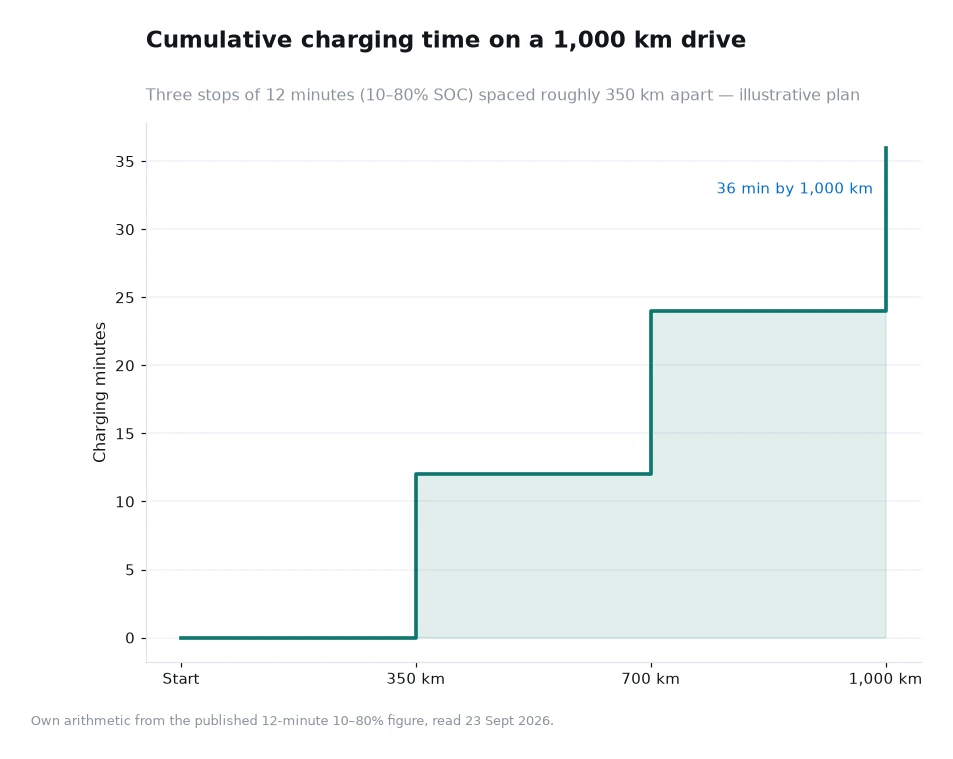
Illustrative plan, not manufacturer data. Assume a 1,000 km return trip, stops spaced roughly 350 km apart, and a rapid charger that takes the car from 10% to 80% state of charge in the published 12 minutes. Three stops cover the distance: 3 x 12 = 36 minutes of charging across the whole trip. Add driving time at an assumed average of 100 km/h, which is 1,000 / 100 = 10 hours behind the wheel, and the stop time is 36 minutes in a 10 hour 36 minute day. For the energy: at the same illustrative 18 kWh per 100 km, 1,000 km uses 10 x 18 = 180 kWh, which at $0.30 per kWh is $54 if it all came from home, and more if a public charger charges a higher rate per kWh. The chart below tracks the same 12-minute stops in cumulative minutes.
Frequently asked questions
How often does an electric car need servicing in Australia?
The published schedule is every 12 months or 20,000 km, whichever comes first, and servicing is recommended through an XPENG Authorised Dealer. Whichever trigger arrives first sets the visit, so a low-kilometre driver still books annually and a high-kilometre driver may book earlier than twelve months.
What does the warranty say about the battery over time?
The key parts term runs 8 years or 160,000 km, whichever comes first, and covers the traction battery, the battery management system, the drive motor and the intelligent power unit. It provides a minimum of 70 per cent of the battery's original capacity during that period, and gradual capacity reduction is described as normal for traction batteries.
Build your own year-one estimate
Write your annual distance, your tariff and your expected consumption on one line, multiply, and you have the variable half of the budget. Then add the fixed half: one scheduled service inside the published 12-month interval, registration, insurance and tyres. Do that before you compare anything, because a running-cost comparison only means something once the assumptions sit in front of you rather than behind a marketing number.
Service intervals, warranty terms and charge times here are as published on the manufacturer's Australian website and read on 23 Sept 2026; the cost figures are my own illustrative calculations and not manufacturer data. WLTP range depends on conditions and battery capacity falls gradually with use, which the warranty terms acknowledge. [1]